Friday, September 27, 2024

Emily Dickinson and E. Lenore Brown at Their Best


Emily wrote a letter about her nephew Gilbert to his mother just after he died which I think is a masterpiece. He was eight years old when he died of typhoid fever. He had lived next door to her in Amherst, Massachusetts, and she appreciated him, and his mother, Susan Gilbert Dickinson, to whom she wrote:


Dear Sue -

The Vision of Immortal Life has been fulfilled -

How simply at the last the Fathom comes! The Passenger and not the Sea, we find surprises us -

Gilbert rejoiced in secrets -

His life was panting with them – With what menace of Light he cried “Don’t tell, Aunt Emily”! Now my ascended Playmate must instruct me. Show us, prattling Preceptor, but the way to thee!

He knew no niggard moment – His Life was full of boon – The playthings of the Dervish were not so wild as his -

No crescent was this Creature – He traveled from the Full -

Such soar never set -

I see him in the Star, and meet his sweet velocity in everything that flies – His Life was like the Bugle, which winds itself away, his Elegy an echo – His Requiem ecstasy -

Dawn and Meridian in one.

Wherefore would he wait, wronged only of Night, which he left for us -

Without a speculation, our little Ajax spans the whole -

Pass to thy Rendevous of Light,

Pangless except for us -

Who slowly ford the Mystery

Which thou hast leaped across!


Emily


This letter has been in my mind for forty years and has given me endless confirmation. She sees what I see, and articulates it. She writes a little more about him to his mother in a later letter:


...”Open the Door, open the Door, they are waiting for me,” was Gilbert’s sweet command in delirium. Who were waiting for him, all we possess we would give to know – Anguish at last opened it, and he ran to the little Grave at his Grandparents’ feet – All this and more, though is there more? More than Love and Death? Then tell me its name!”


I extract those words from Johnson’s 1986 book, Emily Dickinson Selected Letters.


There is a poem from an even more remote source which brings Emily’s letter to Gilbert’s mother into more light. I find it in Poems by E. Lenore Brown, published in 1971 by Highway Bookshop, Cobalt, Ontario, but I can find no information online or anywhere else about E. Lenore Brown. She writes about the recent death of her fifteen year old son:


GRAVE ON THE HILLSIDE


There’s a little grave on the green hillside,

Where lies my little son.

There I climbed to-day, with an aching heart,

When the work for the day was done.


While lingering there as the twilight fell,

It seemed I could hear him ask,

who helps you mother since I am gone?

Who is doing each small task?”


This mother than writes seven stanzas which I omit here in which she expresses ways in which she misses her boy, ending with the tenth stanza as follows:


Dear boy, no one can ever fill your place

At home, at school, at play.

We miss you more and more each day

Than when you went away.”


Modern professional literary criticism might look down on this kind of thing. But I have some acquaintance with Cobalt and of how hard life was there for a mother during that era.


I was going to contrast the tone of this with Emily’s, but no. Both are beyond all that.


Thursday, April 4, 2024

The Last Kingdom of the Heart


Robert Penn Warren:

 “...in the heart’s last kingdom, only the old are young.”   


Those words of Robert Penn Warren have often run through my mind during the last year or so of the public discussion of the age of USA presidential candidates.


My conclusion is that, in the end, after all the considerations about some young people being fresh and open, and some old people being destroyed and insane, Warren got it wonderfully right.


I’m eighty-two now, and I look back to when I was only seventy-two, and realize how much I’ve grown since then, how much more I see now, how much more peace and perspective I have now than then.


I applied to take a program in elementary school teacher training in Ontario when I was sixty-two, twenty years ago, with the idea that I would like to teach elementary school in rural Ontario. My references were good, I had over ten years of teaching at the college level, some experience in secondary school teaching, and had experience in many other ways of life, and was acceptable. But I was told that I would be allowed to teach for only two years after I graduated from the program, the age limit then being sixty-five. Such an age restriction seems almost incredible now.


My grandmother, who was highly qualified in history, English, music, Latin, and German language, had to quit teaching in secondary school in Massachusetts in 1912 because she got married. That now seems inconceivable but it was then a widely-accepted, societal, unassailable belief.


Society itself can improve with age!


Monday, September 18, 2023

At The Great River


I am now at the Great River, the Saint Lawrence River, and can see across to the other side to Canada.


This place has extraordinary beauty. It’s called North Country New York.


The big thing about it during the late summer has been the abundance of wild flowers beside the roads and in the fields, especially the Queen Anne’s Lace and the Blue Cornflower, but the varieties are infinite.


But now the big thing now, early autumn, is the sky. The Great River, Canada, the sun, the city and still the wildflowers though a bit wilted – blues, whites, gold – in inconceivable abundance – beyond what one can see – fields beyond what one can see or imagine.

Friday, July 8, 2022

Recent Glimpse: Charles Drayton Thomas

 We get glimpses of the possibility that it works out far better than we ever could have imagined.

One of those glimpses recently for me has been "Blessed are the meek, for they shall inherit the earth." I have never even heard of anyone actually saying it, believing it, recommending it, or even understanding it. Yet it has been right there in front of us for thousands of years, stunningly beautiful and true.

It's not easy insight for bullies.

The latest glimpse that I got was while reading Charles Drayton Thomas' book. "Life beyond Death with Evidence," (1928).

Charles Drayton Thomas 1867-1953

The following passage is from  p. 184 of that book, and is part of one spiritual conversation of many that he had with his father and sister, who had "died" twenty years earlier.


CBT:  "I gather, from what you have told me, that it will be possible some day to re-enact all the brightest and best scenes from one's earthly life."

Father: "Yes, and also those which one has missed on earth; all that which was possible, but which did not come to fruition. When you come here you will find that which is difficult for me to express. You will realize the good of what you have done, and the happiness which you have had, and beyond that, also, the happiness which you might have had, and which, just because you might have had it, is still yours. This will include the things which were apparently taken from you, but which you let go willingly and not grudgingly; for those things you have made doubly, nay trebly, your own."

CDT: That sounds very beautiful.

Father:  On coming here you will find it is a fact. That which is given up willingly, or which you see taken from you, yet you do not waste time in repining over, you have made yours. Whereas, things which men pursue, are the things they lose.

Tuesday, February 16, 2021

On The Destruction of Kindness


Sometimes I am surprized to find the most helpful bits of wisdom at expected places and times, and which stick with me, transforming my life forever.


There is one problem which is never far from my mind and which always astonishes me when ever I encounter it. I work through it and arrive at a solution, but have never found any confirmation from outside viewpoints which I might read or hear or see in order to hang on to it better than I do.


That problem is how it is possible that genuine kindness is so often hated. My experience is that people pick up on kindness immediately, sense it quicker than animals, and usually try to destroy it.


So I was very heartened to discover the following magnificent passage from “Voices from The afterlife: A Guide to Healing from The Spirit World, “ 1998, by Lily Fairchilde. She is a psychic medium and these words are spoken to her by an Angel, p. 136:


This need to destroy comes from a wounded heart filled with despair. They have rejected love and contracted into a space of fear so deep and overwhelming that they no longer remember who they really are.  These demonic beings are jealous of and bent upon destroying that which they have forgotten that they themselves have. When they see someone who is filled with innocence and light, who would serve the good of the whole, it then becomes their sole intent to annihilate that goodness. If they can not find an opening within the energy field of a light-filled human, they search out someone close by who possesses certain vulnerabilities. They then manipulate that vulnerable human to create discomfort and pain for the person of light, in the hopes that these challenges will cause them to turn away from their Divine source. They feel that if they can destroy all Love in the universe, then they will no longer be reminded of that which they believe is lost to them forever, and their endless pain will cease.


These are, without any doubt, the deepest, most sincere and most helpful words I have read or heard about the problem.

Sunday, August 2, 2020

A Caution for The Kindly, Particularly the Elderly


You may have noticed recently that a tenant decapitated an older gentleman, a nice guy, in Hartford, Connecticut, who was renting a room to him, and wanted to evict the tenant because he was not paying his rent.

                                                Victor King - Beheaded by Tenant

    The victim’s cousin Jim Banks told the Hartford Courant King “was one of the good guys. One that would never hurt a soul. One that would always reach out and help others. He was pleasant as can be. Always seemed to be happy. He was just a joy to be around.” - Buzzfeed News


I had a similar experience last month, only I wasn’t actually decapitated, just figuratively. I allowed a young couple, with two five-year-old boys, to stay in my home, because they said they were new to the city, had no place to live, and needed a couple weeks to get on their feet, get jobs, and a place to stay. It was a long story, with virtue-signaling and expectations of government windfall payments, etc., - all of it fantasies, as I look back on it.


They stayed here three weeks, then called the cops on me when I asked them to leave and said “We have rights” - their exact words.


I was outraged because I had done everything I could to help these young people and their two children – I’d given them a place to say, encouragement, trust, money, rides to the market and such, and was shocked to discover that they would take over my house, refuse to leave, and much more, even bring in a Pit-bull dog to stay.


I asked one of the cops who came if she had ever heard of such a thing – an elderly person allowing a young family to stay in his house, doing every single thing he could to help them in their hour of need, and then having them turn on him, making him a captive in his own house, and refusing to leave.


Her answer was - “It happens all the time” - said with a scowl, and obvious pain.


That’s why I have written this post. “It happens all the time,” so there are other elderly (I am 79) people out there who could be prevented from making the same mistake I made. A caution is timely, being that there are to be more homeless people around in the coming months, due to the ending of certain unemployment benefits, the ending of the moratorium on evictions, and the economic decline.


Yes, I didn’t get decapitated, but I went through hell, because I wasn’t aware of certain realities, some of which are as follows:


1. There are a lot of poor, desperate people around who are living on the edge and who will do desperate things.


2. We have had about two generations now of young people being born into the acceptance of Gingrich-Reagan-Ayn Rand-Milton Friedman-Alan Greenspan-Super Rich CEO's -Greed is Good “Republicans” and their goers-along and enablers. The young couple who took over my home did so because it was perfectly in line with all that. There were no scruples whatever, no shame, nothing like that – just sheer pursuit of one’s own advantage. I was elderly, vulnerable, helpful to others, decent - and their attitude wasn’t even “sorry about that.” Their attitude was nothing even close to “Sorry about that.” It was contempt and murderous hatred. They also thought that I was rich because I have a home, even though I actually am at about zero on the bottom line.


3. To the pure-in-heart, all things are pure. But in fact, one of every three people you see around you in the USA is a Trumpist. They are unshakably convinced that his malice and insanity are good. If you are decent, vulnerable and kind, it calls out a response in such people who are not like you that is, basically, murderous.


4. Finally – although I hope you can add more realities in the comments – There are many well-meaning Democrats who incautiously or naively advocate rent strikes and moratoria on evictions without due consideration for those of us who actually take in the desperate homeless.

Wednesday, April 15, 2020

Worse than The Plague


One of the things I like most about dreams of the night is that they do not back off from reality. If they see that something is wrong, they say it, acknowledge it, and keep after us, repeating the message constantly from different angles, until we admit the truth.

The backing off from the truth has always seemed to me to be like having other gods before us, a violation of the very first commandment, or a form of the first of the seven deadly sins, Pride. I immediately think of C. S. Lewis’s statement that there are those who say to God “Thy will be done” and there are those to whom God says, “OK, we’ll do it your way.”

It may be, however, that dreams stop speaking if there is absolutely no chance that we will ever admit what they are trying to tell us. But I don’t know this as a fact. Dreams do seem to be economical despite a common view that they are senseless, purposeless epiphenomena.

Another aspect of dreams which particularly fascinates me is their connection to the paranormal things like telepathy, remote viewing, foresight, healing, communication with people who have “died” and other spiritual forms such as angels.

I simply can not imagine life without honoring dreams as the most important truth-speakers in my life – I can’t even imagine not paying any attention to my dreams – and yet I know, despite all those who have written about them, that I have personally not met more than three people during my whole seventy-eight years who have the remotest clue of what they are missing. They are simply scornful if you bring up the subject.

I consider this to be a far worse loss for us all than the current Coronavirus plague.

Monday, February 10, 2020

Reading about Death Experiences


The books which have excited me the most recently are in the area of “death experiences” - reports of people who cross over, and then return and tell about it. There are also now many of these reports on YouTube which are spoken by the actual experiencers, giving them an added credibility and import.

The following example is especially helpful because it contains a “distressing” observation of hell. Most NDE accounts do not include that, and I am grateful for, and fascinated by, the literature being written to remedy that lack.


I have personally had a glimpse into the abyss, and have witnessed a psychic attack, and think that the old saying that “The devil’s most dangerous trick is the lie that he doesn’t exist” is probably true. I think it’s fair and helpful to admit that it exists, but also think it’s not something that we can handle with just our own human powers.

I find that these videos carry far more meaning to me than the many attempts to be “scientific” about the experiences, devising variable-correlation experiments to arrive at statistics for prediction and control.

The interest of the ancient Egyptians in the subject is familiar to all of us, but dealing with the problem of death has obviously confronted every human being who ever lived.

I keep coming back to Emanuel Swedenborg, whom I’ve been reading for fifty years, as ultimately being the most helpful in my own attempts to deal with it. I think his “memorable relations” of his talks and experiences with spirits and angels are interesting and true, but the fact that he integrates these experiences with such a large philosophy is what helps me most.

Here is one page from Swedenborg: Life and Teaching, by George Trobridge, 1907, 1933, about the acceptance of his writings:


Thursday, November 14, 2019

Dental Care, Dental Tourism, and Humanness


There was an excellent article in the Huffington Post this morning about “dental tourism” which is well worth reading. It’s about USAers going to Mexico to get dental care that they could not afford nor find in the USA, but also has pertinent words about medical tourism in general.

I have already written a post about going to Mexico for dentistry, but have found such a good dentist in Canada – Dr. David Mady in Windsor, Ontario, only 200 miles away - that I no longer need to go to Mexico.

Getting good dental care in the US, particularly if you’re poor, is excruciatingly difficult and expensive. Dental insurance is pitiful and I often see people here in Dayton, Ohio, who just have all their teeth pulled out because they can’t afford dentistry.

I have often wondered how a millionaire could enjoy his yacht and still be aware, as he must be, of all the children who have tooth pain in his own community. How can he do it?! Everything is known and remembered and is permanent, despite attempts to evade or deny.

But what touched me most about the HuffPo article, despite being on a specific problem that appalls me, is the last paragraph quoting one of the dental patients who travels to Mexico from the USA for dentistry:

Those guys are professionals. They work quick. They work as a team,” Rodman said. “They’re just as nice as they possibly could be. They treat you like a person, you know? You’re not just cattle run through there.

Doesn’t that last sentence just ring your bell? They treat you like a person, you know? You’re not just cattle run through there.”

The solution of every social problem I have encountered seems to me to require that we deepen our humanness – by which I mean our ability to see a situation from the Other’s point of view. I taught a sociology course for many years entitled “Contemporary Social Problems,” and that was the hard lesson of it for me.

Monday, August 5, 2019

Florence Nightingale "Cassandra"


Florence Nightingale's 1850 essay entitled “Cassandra” has received an immense amount of scholarship.

It's about the absurdity, horror, evil, and counterproductiveness of trying to exclude women from full life, which I believe basically to be a form of mass murder.

The essay is concentrated, passionate, deeply insightful and intelligent, and based on experience.

The version which I have just read is about thirty pages long, from The Feminist Press. Strangely, I have been able to find only a very few brief excerpts and abridgments online, even though it was written in 1850.

I think that this essay contains all the essentials of the problem, the problem of the devaluation and exclusion of women, the problem which I think is the most fundamental, important, problem in the world.

Here is just one short passage that struck me strongly:


We set the treatment of bodies so high above the treatment of souls, that the physician occupies a higher place in society than the schoolmaster. The governess is to have every one of God's gifts; she is to do that which the mother herself is incapable of doing; but our son must not degrade himself by marrying the governess, nor our daughter the tutor, although she might marry the medical man.

But my medical man does do something for me, it is said, my tutor has done nothing.

This is true, this is the real reason. And what a condemnation of mental science it is! Low as is physical science, that of the mind is still lower.

Women long for an education to teach them to teach, to teach them the laws of the human mind and how to apply them - and knowing how imperfect, in the present state of the world, such an education must be, they long for experience, not patch-work experience, but experience followed up and systematized, to enable them to know what they are about and where they are “casting their bread” and whether it is “bread” or a stone. (p. 39)


Wednesday, May 8, 2019

Is Trump A New Low or Has It Always Been Like This?


My friend thinks Trump is a new low, what with caging and separating children, the constant lying, the fear-mongering, and all that. Pinker and Gates and people like that think life is getting better. But I myself think that it’s always been this way.

I grew up in the USA during 1950’s and remember what high school and Pennsy Prep were like. I remember my university and graduate schools being essentially poison.

I saw what the USA did to me for opposing the Viet-Nam and Iraq invasions and crimes, and I remember the assassinations.

The “Howl” resonates from long before Lear to the Now of organized crime, the medical industry, consciously enshrined selfishness, the “elites.” Two twelve-year-old girls on my street alone got pregnant this year and that very bright ten-year-old girl from the next street who visits me once in a while loves books but has never been to a library in her life.

Sarah Silverman came the closest in her Thanksgiving Monologue that I can come to seeing a positive development – the fact that Trump is so absurd that more people than ever can see The Great America for what it actually is. And then there is Elizabeth Warren and Bernie Sanders and Alexandria Ocasio-Cortez and all the uncounted millions who support them and wish them well and thank them.


I look at this now, as an old man close to death, and feel that Trump is not a new low, but that it has always been like this. Perhaps that is in accord with what I think is the answer to the theodicy question: Namely, evil exists so that we can know, appreciate, the difference.

Saturday, February 23, 2019

Visions of the Blind


Once in a while I come across a few lines in my reading that just resonate throughout my being, and I record them in my note book, and find them inside me ever after, with warmth and joy and light.


The article itself is memorable but what struck me most inside it was the testimony of a blind-from-birth lady of what she saw while she was out of her body. The authors of the article interview her and write, p. 111:

... she then "rolled out" to find herself lying on grass. She was surrounded by trees and flowers and a vast number of people. She was in a place of tremendous light, and the light, Vicki said, was something you could feel as well as see. What the light conveyed was love. Even the people she saw were bright and reflected the light of this love. "Everybody there was made of light. And I was made of light. There was love everywhere. It was like love came from the grass, love came from the birds, love came from the trees." Vicki then became aware of five specific persons she knew in life who were welcoming her to this place. Debby and Diane were Vicki's blind schoolmates, who had died years before, at ages 11 and 6, respectively. In life, they had both been profoundly retarded as well as blind, but here they appeared bright and beautiful, healthy and vitally alive, and no longer children, but, as Vicki phrased it, "in their prime."

Now, every syllable of that rings with me and the thought of sharing it with even one other person feels like heaven, too. And even beyond that, comes the vision that my friend Colleen is there. Now.

Colleen Large and Me, Victoria, BC, Summer, 2018.


Saturday, January 5, 2019

Some Meta Remarks, Particularly on The Generals and Norman Morrison


The ending of the Old Year and the beginning of the New Year is always a special time for me. There is the excitement of wondering what the New Year will bring, wondering what presently-unimaginable thing I will be looking back at exactly one year from now.

Perhaps I can post more articles on this blog during the coming year than I did during this past year. I would like to do that.

The reason I didn't post very much during this past year was that I was out upon the land most of the year, in the USA and Canada. I rented out my home in Ohio early on, then took off, at seventy-seven years of age, to see what I could see for a year, while I was still able. I saw a lot, connected to a lot, and survived it so remarkably well that I am going to try it again for an other year.

Helen Keller said: “Life is either a daring adventure or it is nothing.”


There are just so many topics that have preoccupied my mind recently that I need to write about some of them, particularly the subject of psychopathy (generally meaning sociopathy, anti-social personality disorder and even malignant narcissism) and the subject of Near-Death Experiences. I have been reading recently in these areas and am just astonished at how much has been done in them in during the last twenty years, never mind forty years.

I have also been astonished to see that two of my blog postings over the past year which have received the most “hits,” the most read around the world, have been my review of Thomas Hicks' book, The Generals, and my article on Norman Morrison.

I wrote those two articles right out from my soul, very much expecting that there might well be only one single soul out there in the rest of the whole world who would read them or understand them. I knew that I spoke the truth.

I also did absolutely nothing to promote them, nothing to draw attention to them. And yet they are two of my most popular, most-read, articles.

Amazing. Provoking.


Thursday, October 11, 2018

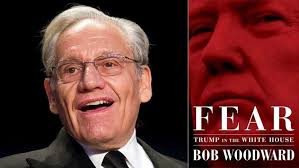
“Fear: Trump in the White House” by Bob Woodward


I was travelling, camping, talking with people across the Canada, when Woodward’s book came out in August of this year. Every bookstore I visited was sold out of the book. “It’s freaky,” said the bookseller in Owen Sound, “We sold out the first day.”

There was great interest, due to Woodward’s
reputation as a truthful, informed and courageous reporter. He uses a tape recorder, and has “access.”

But what I was looking for even more than the reporting and quotes was his insight into Trump himself. He uses a March 31, 2016, quote from Trump at the beginning of the book just before the Note to Readers:

“Real power is – I don’t even want to use the word – fear.”

He draws his title from it and uses it a couple times later in the book, but does not seem, to my eyes, to develop much of that insight into Trump. Perhaps in his wisdom he just assumes that ordinary people like me will be able to see from all the reporting in the book that Trump works and plays with fears.

But where I could really see what he thought was in the last paragraph of the last page of the book, where he writes of John Dowd’s resignation as Trump’s lawyer. Dowd, very experienced and astute, supports and likes Trump and was aware of his limitations, resigned because Trump would not take his advice.

Woodward’s last paragraph reads:

But in the man and the presidency Dowd had seen the tragic flaw. In the political back-and-forth, the evasions, the denials, the tweetings, the obscuring, crying “Fake News,” the indignation, Trump had one overriding problem that Dowd knew but could not bring himself to say to the president: “You’re a fucking liar.”

It’s not clear to me that this fatal flaw directly relates to the”Fear” of the tile, but it may. Woodward reports two pages earlier Dowd as saying something that gets a little closer to the fear idea. He is telling Trump that he doesn’t have to worry about being impeached and says:

They’re not going to impeach you. Are you shitting me? They’re a bunch of cowards, the whole town. The media, the Congress. They’re gutless.

So perhaps that was the fear that Woodward was referencing – the fear, the true cowardice, within not just Washington but the US public itself.

Saturday, August 4, 2018

Canadian Comfort

I’ve been in Canada for the last three months, taking a break from my life at home in the USA. Certain realities catch my notice quickly here.

The first thing I notice when I cross the border into Canada, which I do several times per year, is that my body feels more relaxed here.

I also feel hopeful. It’s as if the very fact that there is a place so close by which is not Hobbesian, not basically violent, reaffirms that feeling.

What I call “the Hobbesian view” brings a sense of urgency and doom with it, and a dismissal or diminishing awareness of the fundamental power of love and cooperation.

I notice here at least twice a day, every single day, some act of helpfulness or kindness, whereas I almost never see such things in Dayton, Ohio.

These observations may seem naive at first, and I am very aware of stereotyping and the weakness of national character studies. But the reality is nonetheless there and cannot be dismissed.

I’ve given a lot of thought over the years to the game of hockey, which I myself consider to be brutal, yet here seems to be considered honorable or even symbolic of the country in some way. I admit that I haven’t figured it out, that it seems anomalous to me. Even mature women here admire the game. Perhaps it’s one way of dealing with the inevitable reality of brutality in life, in the world. 


Saturday, December 23, 2017

Minsky and Me and Steve Keen on The Turning Point – 1966


Steve Keen is a dissident economist who seems to have the large perspective that I like, although I myself do not fully understand the details of his discussions.
Steve Keen
He contends that mainstream economics does not understand what money is. That just rings so true to me. One of my colleagues, an economist, told me candidly many decades ago that economists do not know what a dollar is. It seems incredible but it fits with everything I know about symbolic interaction.

Steve Keen was one of the very few economists who foresaw the 2007 collapse.

Here is another matter that I have thought about for over forty years, which he mentions in his classic, 2011 book, Debunking Economics –Revised and Expanded Edition: The Naked Emperor Dethroned?He writes on p.339: 

Minsky himself identified 1966 as the time at which America made the transition from a productive to a Ponzi economy.

Nineteen sixty-six was the point at which the US decided it was all right to kill people in Viet-Nam even though everyone could see that there was no valid reason for it, that the war was false and unjustified. Even children knew it was wrong. It was a conscious decision by the country that what it did in Viet-Nam was justifiable, that the war was legitimate, that murder was acceptable. The Senate walls dripped with blood, said George McGovern, and the electorate showed him what they thought of his truth speaking – he lost every state (except Massachusetts) to Richard Nixon, an obvious criminal.

I remember 1966 very well. Viet-Nam, the USA’s invasion of Viet-Nam, was the big question, and the nation’s refusal to stop doing it, after everyone, including the government, knew it was immoral, was the disconnect point from any attempt to be true and good. That was the breaking point for the US – socially, morally, economically.

Chicago Democratic Convention in 1966

Chicago Mayor Richard Daley in 1966
What Minsky and Keen are saying is that 1966 was the point at which we overtly shifted from a productive economy to a Ponzi economy, and what I say is that it was also the point at which the USA overtly became selfish, irredeemable, consciously criminal. After 1966, and particularly after the events at the Democratic National Convention that year, it became openly understood and acknowledged that the USA is a murderer and no one is going to do anything about it.

I read recently an elite academic who referred to “the carefree ‘sixties.” That’s a good indication of how far the country is lost.

Steve Keen does not talk about Viet-Nam specifically, as far as I know, but there are many good clips on YouTube in which he talks of what has been going on economically since then, and what he sees in the future. Here is a relatively short and understandable interview:


Thursday, November 23, 2017

Galway Bay


The 1947 “Galway Bay” is one of those songs which I’ve heard many times, sung by many respected singers, such as Bing Crosby. But it wasn’t until quite recently, in my seventy-sixth year, that the depth of its mythic quality was brought home to me, and then by a young woman named Chloë Agnew:

She sings of the ladies digging praties (potatoes) in the uplands who speak a language that the strangers do not know and the play of the gossoons (garçons). She sings of the possibility of life hereafter, of the land across the sea, about dehumanization, all that good stuff which is missed by the standard academic, analytic, scientistic, best and brightest, respectable worldview. It has got “England” vs. Ireland in it, too, and the closing of our days.

The closing of my own days is now, to me, given how quickly time is flying. And that has to be why I am now able to be so appreciative of Chloë’s Galway Bay, beside which the other renditions seem so jaded in contrast. But I think also it was necessary for me to live through the absurdities and horrors of the “standard academic, analytic, scientistic, best and brightest, respectable worldview” - for several decades.

It’s as if it were all right there right before my eyes all the time, but that I had to experience hell in order to appreciate it.


Galway Bay

If you ever go across the sea to Ireland,
Then maybe at the closing of your day;
You will sit and watch the moonrise over Claddagh,
And see the sun go down on Galway Bay,
Just to hear again the ripple of the trout stream,
The women in the meadows making hay;
And to sit beside a turf fire in the cabin,
And watch the barefoot gossoons at their play,
For the breezes blowing o'er the seas from Ireland,
Are perfum'd by the heather as they blow;
And the women in the uplands diggin' praties,
Speak a language that the strangers do not know,
For the strangers came and tried to teach their way,
They scorn'd us just for being what we are;
But they might as well go chasing after moonbeams,
Or light a penny candle from a star.
And if there is going to be a life hereafter,
And somehow I am sure there's going to be;
I will ask my God to let me make my heaven,
In that dear land across the Irish sea.


Saturday, November 11, 2017

A Short Passage from Freud’s “An Autobiographical Study”


It sometimes seems to me that the most remarkable and astonishing mistake I’ve ever heard of is the belief that growing old is a bad thing and that youth is the best time of your life.

Yes, there are probably other whoppers like it, maybe even more absurd. Maybe the pretensions of the elites that are becoming more obviously tragic and deserved, have equal rank, but this particular one stands out for me now.

The immediate case before me is my recent re-reading of Sigmund Freud’s little book, “An Autobiographical Study,” and especially a short passage in which he recounts what he believes are his two contributions to the understanding of sexuality. The book as a whole is Freud’s 130-page reflection and summation of his life’s work as he approaches his end.

I’ve read this little book a few times over the course of the last fifty years, and paid attention to his other books which are necessary to understand it. And this particular passage below now seems to me to be so trivial, such a simple restatement of the longtime youthful delusion, that it’s a great joke – awful yet funny at the same time. Have a look, p. 70:

In the first place, sexuality is divorced from its too close connection with the genitals and is regarded as a more comprehensive bodily function, having pleasure as its goal and only secondarily coming to serve the ends of reproduction. In the second place the sexual impulses are regarded as including all of those merely affectionate and friendly impulses to which usage applies the exceedingly ambiguous word “love.” I do not, however, regard these two extensions as innovations but rather restorations: they signify the removal of inexpedient limitations of the concept into which we had allowed ourselves to be led.

It’s effectively a restatement of the reverse, upside-down, reality that entails Donald Trump as the President of the United States. It's the selfish, solipsistic, egotistic position and Freud used his life to refine and promote it. 

But I more deeply see as I grow older that this position is error and horror, and that getting out of selfishness is much more truthful and fun!


Tuesday, August 8, 2017

“The Unseen Presence of Victorious Corruption”


Sometimes there are words that make music, without sound or rhythm, just by the truth they present.


Joseph Conrad uses such musical words - “...the unseen presence of victorious corruption...” - in his story, The Heart of Darkness, when the narrator reaches the up-river station in the jungle and meets the dying station master, Mr. Kurtz. He describes his feeling about colonialist dehumanization, soulless science, commercial exploitation, slavery and murder as follows:

    “It seemed to me I had never breathed an atmosphere so vile, and I turned to Kurtz for relief – positively for relief. ‘Nevertheless, I think Mr. Kurtz is a remarkable man,’ I said with emphasis. He [another corrupt company official] started, dropped on me a heavy glance, said very quickly ‘He WAS,’ and turned his back on me. My hour of favour was over; I found myself lumped along with Kurtz as a partisan of methods for which the time was not right: I was unsound! Ah! But it was something to have at least a choice of nightmares.
    “I had turned to the wilderness really, not to Mr. Kurtz, who, I was ready to admit, was as good as buried. And for a moment it seemed to me as if I also were buried in a vast grave full of unspeakable secrets. I felt an intolerable weight oppressing my breast, the damp earth, the unseen presence of victorious corruption, the darkness of an impenetrable night...”

This whole passage, even the whole book, is a masterpiece awe-inspiring art, but this phrase about the unseen presence of victorious corruption just rang my soul, seemed like it expressed my whole life.

Sven Lindqvist
I had recently finished reading Sven Lindqvist’s “Exterminate All the Brutes”: One Man’s Odyssey into the Heart of Darkness and the Origins of European Genocide,” which treats of Conrad, the background at the end of the nineteenth century, and what happened in the next forty-five years. “Exterminate all the brutes,” are Kurtz’s words. Lindqvist had written:

    And when what had been done in the heart of darkness was repeated in the heart of Europe, no one recognized it. No one wished to admit what everyone knew…
    “Everywhere knowledge is being suppressed, knowledge that, if it were to be made known, would shatter our image of the world and force us to question ourselves – everywhere there, ‘Heart of Darkness’ is being enacted…
    “You already know that: So do I. It is not knowledge that we lack. What is missing is the courage to understand what we know and draw conclusions...”

Lindqvist mentions how Conrad, who was friends with H.G. Wells at the time, had just read Wells’ new book, “The Invisible Man,” as he was writing “The Heart of Darkness” and this resonated with the “invisible” aspect of the “vile atmosphere.”

I first read the Conrad story when I was in my twenties, and then again when I was middle-aged, but when I read it now in my old age I am able to see infinitely more meaning and music in it. England and France especially, the atmosphere of Triumphant Progress at the turn of the century, then World War One and World War Two, the U.S. invasions of other countries, and the whole wretched 20th century are more known to me than before. My earlier readings now seem pathetically bleak.

Just this one phrase, “...the unseen presence of victorious corruption...” - strikes a dominant chord of my experience on this planet from the time I first went away to school right up to my contact this afternoon with the medical and banking industries.