Wednesday, September 17, 2014

Jimmy Carter, “A Call to Action”

Jimmy Carter says in his new book, “A Call to Action,” that the most important issue the world needs to face is the enhancement of women's lives. The first sentence on the flyleaf reads: “The world's discrimination and violence against women and girls is the most serious, pervasive, and ignored violation of basic human rights: This is President Jimmy Carter's call to action."


I thought several times as I was reading the book of Diane Ravitch's writing that the the first step in true reform of education is to assure adequate prenatal care for women.

Carter went on the Charlie Rose Show recently to promote and to discuss his book, but Rose seemed just to want to discuss Israel. Carter politely told him a couple times that he wanted to discuss the book, but Rose clearly was not interested. However, I heard enough to know that I had to read the book.

Jimmy Carter has an awe-inspiring list of accomplishments. Just his eradication of Dracunculiasis, called guinea worm disease (GWD), in Africa is inconceivably magnificent, in my eyes. He has done so much more and is still very much doing it at ninety years of age.

He writes a lot in his first chapter about the misinterpretations of religious scriptures that promote the destruction of women's lives. Rightly so, but I was more struck by the passages later in the book in which he points out that it is actually women who make things work.

Here are some quotes from the book, for the truth of them, and to provoke your interest in the book, and simply for sharing:


p.70. Of even greater significance is what we have learned about the vital role that women can play in correcting the most serious problems that plague their relatives and neighbors. Almost everywhere, we find that women are relegated to secondary positions of influence and authority within a community but almost always do most of the work and prove to be the key participants in any successful project.

p.156. There have been surprising reductions [of Female Genital Cutting] in Kenya and Central African Republic. It is not clear why this is so, but it seems obvious that outside pressure has had little effect except in encouraging the education of young women...A public opinion poll that same year [2008] revealed that only a third of the younger women wanted to see the practice continued, while two-thirds of the the older women supported its continuation. Because the decision to perform FGC is made almost exclusively by mothers, without consulting their husbands, these numbers give hope that the next generation of daughters might be spared.

p.193, quoting Ela Bhatt: “I have faith in women...In my experience, as I have seen within India and in other countries, women are the key to rebuilding a community. Why? Focus on women and you will find an ally who wants a stable community.”

p.35. There are now more than five times as many American inmates in federal, state, and local prisons as when I was president and the number of incarcerated black women has increased by 800 percent! An ancillary effect is that this increased incarceration has come at a tremendous financial cost to taxpayers, at the expense of education and other beneficial programs The cost of prosecuting executed criminals is astronomical. Since 1973, California alone has spent roughly $4 billion in capital cases, leading to only thirteen executions, amounting to about $307 million spent for the killing of each prisoner...Despite the proliferation of excessive imprisonments, the number of pardons by US presidents has also been dramatically reduced. I issued 534 pardons in my four-year term, and in their eight-year terms, Ronald Reagan issued 393, Bill Clinton 396, and George W. Bush 189, but in his first term Barack Obama issued only 23.

Saturday, September 6, 2014

Leonard Cohen on Montreal


Beware of what comes out of Montreal, especially during winter. It is a force corrosive to all human institutions. It will bring everything down. It will defeat itself. It will establish the wilderness in which the Brightness will manifest again. [The first paragraph of “Montreal”]


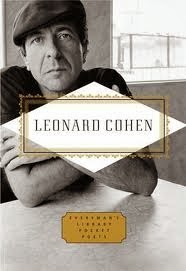
There is a short piece of prose, entitled “Montreal,” in the recent Everyman's Library Pocket Poets selection of Leonard Cohen's poems and songs, a book well worth owning.

The city of Montreal has been particularly important to me because I lived there for four years as a student, attending the same university that Cohen attended. It was an overwhelming experience for me, even annihilating, so I've given it a lot of thought over the fifty years since then, trying to bring bits and pieces of it together.

Now, this "Montreal" poem feels clarifying, solidifying and delightful to me. I find that it pulls together most of my experience of Montreal. I've often thought of how Cohen once said that he “realized” that “Suzanne” was a Montreal song, because I felt that it was, too, but now I see Montreal in many other places in his thought.

I believe also that what Cohen says about Montreal in this poem applies to every other gathering of people I've experienced – annihilation then a protection. Finding or developing the protection can take fifty years or more, however!

Here's the remaining paragraph of “Montreal:”
  
We who belong to this city have never left The Church. The Jews are in The Church as they are in the snow. The most violent atheist defectors from the Parti Québécois are in The Church. Every style in Montreal is the style of The Church. The winter is in The Church. The Sun Life building is in The Church. Long ago the Catholic Church became a pebble beside the rock on which The Church was founded. The Church has used the winter to break us and now that we are broken we are going to pull down your pride. The pride of Canada and the pride of Quebec, the pride of the left and the pride of the right, the pride of muscle and the pride of heart, the insane pride of your particular vision will swell and explode because you have all dared to think of killing people. The Church despises your tiny works of death and The Church declares that every man, woman, and child is protected.

Cohen recently said that his long-term depression "has lifted” but my own view is that we are, or should be, rightly very troubled at how upside down and backward the world has become, or is, and that it takes one's whole lifetime's thought-work to resolve the big questions of our unique souls with regard to the situation.

He has a new album, “Popular Problems,” coming out later this month, on his 80th birthday.


Friday, August 29, 2014

Joyce on the Infinite and the Infinitesimal

Taking the largest possible perspective on things makes me appreciate them more deeply, even though it sometimes seems like this is a cold, heartless, annihilating approach. Taking the largest perspective possible draws me closer to my loved ones and makes me appreciate them more while I am here.

I happened to be reading James Joyce's “Ulysses” recently and came across a passage in which he is writing about what I am calling “the large perspective.” He writes about the incomprehensible expanse out there as well as inside the small. I've elsewhere read a few attempts (Here is one which also quotes Joyce directly) to express this large perspective which were a little clearer than Joyce's attempt. Yet his is worth reading and goes as follows:

   The heaventree of stars hung with humid lightblue fruit.

   With what meditations did Bloom accompany his demonstration to his companion of various constellations?


  Meditations of  evolution increasingly vaster: of the moon invisible in incipient lunation, approaching perigee: of the infinite lattiginous scintillating uncondensed milky way, discernible by daylight by an observer placed at the lower end of a cylindrical vertical shaft 5000 ft deep sunk from the surface towards the centre of the earth: of Sirius (alpha in Canis Major) 10 lightyears (57,000,000,000,000 miles) distant and in volume 900 times the dimension of our planet: of Arcturus: of the precession of the equinoxes: of Orion with belt and sextuple sun theta and nebula in which 100 of our solar systems could be contained: of moribund and of nascent new stars such as Nova in 1901; of our system plunging towards the constellation of Hercules: of the parallax or parallactic drift of socalled fixed stars, in reality evermoving from immeasurably remote eons to infinitely remote futures in comparison with which the years, threescore and ten, of allotted human life formed a parenthesis of infinitesimal brevity.


   Were there meditations of involution increasingly less vast?

   Of the eons of geological periods recorded in the stratifications of the earth: of the myriad minute entomological organic existences concealed in cavities of the earth, beneath removable stones, in hives and mounds, of microbes, germs, bacteria, bacilli, spermatazoa: of the incalculable trillions of billions of millions of imperceptible molecules contained by cohesion of molecular affinity in a single pinhead: of the universe of human serum constellated with red and white bodies, themselves universes of void space constellated with other bodies, each, in continuity, its universe of divisible component bodies of which each was again divisible in divisions of redivisible component bodies, dividends and divisors ever diminishing without actual division till, if the progress were carried far enough, nought nowhere was never reached.

I take this humbling increasingly seriously as I come closer to death, although it is only too easy to lapse into the shorter perspective in which I think that things like “survival” are important.

But it doesn't involve a coldness or lack of love and appreciation. Just the opposite is true. Perhaps there is some way in which the vastness really is not that important or annihilating after all. Perhaps we know immediately that love is the central point and all the rest is derivative or secondary to it.

Sunday, August 17, 2014

The Ferguson Photos

The recent photos of over-armed police pointing guns at unarmed people in Ferguson, Missouri, have a special resonance with me and apparently to many other people. I've thought a lot about the question of why this is, why these images are so exciting to me, why they are so deeply familiar and meaningful.

The best understanding I can come up with, that I keep coming back to, is that these photos express exactly how I have personally felt going to school and college, living in the USA during the Civil Rights fight and the Viet-Nam and the Iraq wars and  the Reagan-plus years of programmatic selfishness and the hatred-of-Obama years.

The very popularity of such photos as these is a great ray of hope because it suggests that humanity is alive and even unkillable despite all these years.


Monday, August 4, 2014

That Silver Haired Daddy of Mine

Gene Autry wrote a song in 1932 entitled “That Silver Haired Daddy of Mine.” The first time I heard it was about twenty years ago, shortly after my own father died, when I happened to be wandering around an old antiques shop in Massachusetts near where he was born. The shop was playing it as background music but it had a great effect on me at the time and I've often thought of it since then.

Many singers have covered it. Marty Robbins' version, below, has been one of the most popular and is worth hearing, although I myself am partial to Mac Wiseman's version. Wiseman has done some Romantic things that seem simply incomparable to me.


Hank Snow, the Canadian singer, wrote a sequel to it, in which he has the father responding to the regret by saying “Just come see me.”


Now, it goes through my mind that the versions of this old Gene Autry song are not as well known or respectable as, say, the parable of the Prodigal Son or Rembrandt's painting of the silver-haired, old father embracing the repentant son, but that they are working on the same thing. Old, popular classics often carry the mythic with them.


In a vine covered shack in the mountains
Bravely fighting the battle of time
There's a dear one who's weathered life's sorrows
It's that silver haired daddy of mine.

If I could recall all the heartaches
Dear old daddy, I've caused you to bear
If I could erase those lines from your face
And bring back the gold top your hair.

If God would but grant me the power
Just to turn back the pages of time
I'd give all I own if I could but atone
To that silver haired daddy of mine.

I know it's too late, dear old Daddy
To repay for the sorrows and cares
Tho’ dear Mother is waiting in Heaven
Just to comfort and solace you there.


Sunday, July 20, 2014

Yelling at Children

The fourth of July celebrations of USA Independence Day seemed unusually hollow this year to me because of the reaction of USA citizens to the arrival at the USA-Mexico border of large numbers of war refugee children and mothers. These poor children and their mothers were seen here as “a threat to our very existence,” had their buses blocked by USA patriots and even received death threats.

The best single comment I read on the occasion was from Duncan Black:

     “July 4th:  Should we yell at some poor children or something?”

This occasion seemed to me to be a new low for the US and I tried writing something out to that point, but soon realized that it was not at all a new low.

Tuesday, July 1, 2014

Canada Day 2014 - My Appreciation


I used to love going to Canada, particularly between 2001 and 2008, when I had a big truck. I had some very good friends there, too, and lots of memories.

But something went wrong over time so that I got “flagged” in the Canadian customs/immigration computer for something- they never tell you what it is, why – so I eventually came to feel that this country I loved so much had something against me. Every time I would cross the border, I would get detained and grilled and then seemingly grudgingly and suspiciously admitted.

I talked with an older, decent, kind, truly experienced Canadian customs official about this one day when I crossed the border into Cornwall, Ontario. He relieved a lot of the sourness I was developing by saying to me: “Don't take it personally, it's just the rules,” and by recognizing my love of Canada and sharing his love of Canada with me. I told him about how I used to feel coming across that high bridge over the St. Lawrence and seeing the lights of Cornwall spread out down there before me on the other side. He spoke of Manitoba. That old guy represents Canada to me. Yes, Canada has its problems, but here was the heart of it.

Crossing the other way, from Canada into the US, was an entirely different matter. I was not “flagged” in the US customs for anything. The trouble I ran into there had nothing to do with “rules,” and in fact the problem was just the opposite – no rules. The absolute worst US customs officials and border guards were at Port Huron, Michigan, where you come in from Sarnia, Ontario. These guys were simply sadists – swaggering, violence-obsessed, self-important, vicious bullies. I don't have the vocabulary.

The idea that “It's just the rules” does apply in Canada, in general.

The idea in the US is that rules and justice are bullshit, and that the essence of “America” is exactly that. I will do just whatever the hell I want and screwing you over, eventually destroying you, is the best part of that.